torsdag 24 april 2014

Today's session

We are preparing a submission of our work on printed electrode to the SSOCC conference. The conference is this year in Vadstena, in the western parts of county of Östergötland.
As references we have two interesting papers on:
  • "A Review of Wearable Antenna"
  • "New Wideband Printed Antennas for Medical Applications"
onsdag 26 mars 2014

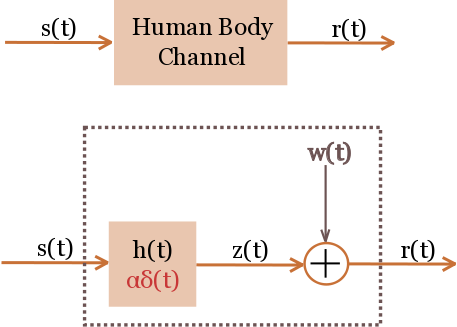
A simple mathematical model for attenuated HBC channel


It has been proven widely and largely by a number of researchers that human body is essentially an attenuated transmission channel. This means that this attenuated channel could be modeled as a deterministic linear time-invariant filter with impulse response h(t) as shown in the figure below.


In this case h(t) could be represented as,

H(f) is the fourier transform of h(t) expressed as,


In this figure s(t) is the transmitted signal, w(t) represents additive white gaussian noise and z(t) is the convolution of s(t) with h(t).

In frequency domain, fourier transform Z(f) of z(t) is given by,

 So r(t) is given by,
If  is very small then signal z(t) would be very weak as compared to noise and interference represented by w(t). This will reduce performance of the receiver and because of this reason communication distance could also not be very large between transmitter and receiver.

This derivation has been adopted from "Introduction to Digital Communications" compendium written by Göran Lindell, LTH, Lund University.

måndag 17 mars 2014

60-Hz power line interference with human body

60-Hz power line interference could either couple through electromagnetic induction or through electrostatic induction to the underlying circuit.


Electromagnetic Induction

The magnetic field due to mains supply current induces electromotive force (emf) in the electrodes, associated lead wires and preamplifier of the BAN trannsceiver. The greater the loop area covered by the mains supply current, the larger is the value of induced emf. However when the same electrodes, lead wires and preamplifier are worn on the body, there is very little amount of induced emf in the receiver due to much lesser loop area.


Electrostatic Induction

In case of electrostatic induction, the mains supply current gets capacitively coupled to the human body. The body-to-ground capacitance plays an important role in introducing interference as the pre-amplifier is also isolated from true earth or gound in battery held devices. A displacement current therefore flows through the human body which produces common mode voltage at the electrodes with respect to ground. 

It is assumed that electrostatic induction is the dominant form of interference for BAN transceiver rather than electromagnetic induction.

söndag 23 februari 2014

HBC channel defined by IEEE 802.15.6


IEEE 802.15.6 channel modeling subcommittee has approved measurements for frequency range 13.550 to 13.571 MHz and the surprising result is that human body exhibits almost similar path loss as that of free space for a narrow band of 21 kHz. According to these measurements, signal amplitude reduction through the regions of hand, wrist, torso (front to back), thigh, ankle, left to right ear is 3.3 %, 2.8 %, 3.4 %, 1.9 %, 2.8 % and 2.0 % respectively [1]. 


It has also been specicified that human body can be used as a communication channel from 5 to 50 MHz without need of any modulation. It has been shown that for a transmission distance of 150 cm from the fingertips of one to the fingertips of the other hand with receiver load impedance of 10 M-ohm and electrode sizes of 2x2 cm2 the amplitude and phase mean value of response is as follows at different frequencies [1].


5 MHz
10 MHz
20 MHz
30 MHz
40 Mhz
50 Mhz
Amplitude (dB)
-47.2 dB
-48 dB
-48.65 dB
-50.7 dB
-52 dB
-54.8 dB
Phase (degrees)
-29.2 º
-47.4 º
-87.7 º
-117.6 º
-150 º
- 172.7 º

The channel also exhibits Gaussian noise with zero mean and 2.55×10⁻⁵ variance.


References


[1] K.-Y. Yazdandoost and K. Sayrafian, “Channel model for body area network (BAN),” 15-08-0033-04-0006-draft-of-channel-model-for- body-area-network.doc https://mentor.ieee.org/802.15/file/08/15-08-0780-09-0006-tg6-channel-model.pdf

torsdag 20 februari 2014

Thursday discussion

Today there were intense discussions on amplifiers and rejection ratios.

tisdag 18 februari 2014

Health and monitoring circuits

Texas Instruments discusses the use of their circuitry in so called bio-patches. A way to monitor the health and cognitive behavior of a person. Quite a lot of speculation though at the moment, but yet. There are a few other interesting points on sensor hubs, etc., in the Jan 2014 issue of the magazine.

söndag 16 februari 2014

Effect of electrode configuration on signal transmission through human body communication channel


 There could be two simple types of electrode configurations with respect to dominant electric field direction on the surface of human body channel:

One  type could be the coplanar capacitor formed by placing signal electrode adjacent to  ground  electrode or inter-digitated signal- and ground-fingers in the horizontal plane with the assumption of horizontal direction of electric field vector.

 The  second type could be the overlapping capacitive electrode formed by placing the signal  and  ground electrodes in the vertical plane. The direction of electric field intensity vector is  assumed vertical in this configuration.

 For  both configurations of electrodes, we are forming some kind of electrical dipole on the  surface  of human body. The electric field intensity has been calculated on the surface of  human body with finite permitivity and conductivity for the vertical infinitesimal electrical  dipole in [1]. However, it's also important to calculate electric field intensity for horizontal  dipole in order to compare the two coupling schemes and decide which one is better.

If  the human body acts as a waveguide medium as claimed in a european patent [2] then it's important  to see, for which component of electric field vector (horizontal or vertical) human body serves as a better medium. For example, it could be that human body attenuates one component of electric field say horizontal more than the other component of electric field say vertical. This would then define the better configuration of electrode for signal transmission on human body if we assume that the vertical component of the electric field is produced by the overlapping electrode configuration and the horizontal component of electric field is produced by the coplanar electrode configuration.


References


[1] J.Bae, H. Cho, K. Song, H. Lee, and H.-J.Yoo, “The Signal Transmission Mechanism on the Surface of Human Body for Body Channel Communication,” IEEE Trans. Microw. Theory Tech., vol. 60, No. 3, pp. 582-593, March 2012

[2] R. Bedini, A. Buratto, G. Casadio, G. Palagi and A. Ripoli, “Transmission system using the human body as waveguide,” European Patent EP0824889 A1, Feb 25, 1998.

söndag 9 februari 2014

A qualitative overview of modulation schemes for body channel communication


Analog Modulation AM, FM/PM
Human body suffers from amplitude fading for different environmental and surrounding conditions. Moreover it is subjected to different electromagnetic interference patterns which also deforms the amplitude. Therefore analog amplitude modulation (AM) is not favorable for such a channel. Moreover, AM has lower noise immunity than frequency (FM) or phase (PM) modulation which are harder to distingish from each other when modulation is in analog domain and also requires PLL or VCO (more complex circuitry) for generating accurate frequency. SNR improves quadratically at the expense of transmitting BW for FM but there is no such tradeoff in case of AM. 

Pulse Modulation PAM, PWM, PPM
Pulse modulation schemes offer higher SNR at the expense of larger BW than analog modulation schemes by allowing analog signal to be represented as a periodic pulse train and varying either pulse amplitude, pulse duty cycle or triggering pulse modulated signal at rising or falling edge etc proportional to the sampled value. 

Digital Modulation
Pulse code modulation (PCM) involves both time sampling and digital encoding or quantization of analog signal before transmission. The resolution of ADC ensures higher SNR. Different line codes like unipolar/ bipolar NRZ, unipolar/ bipolar RZ, Manchester and differential encoding could be used with this scheme. Other digital modulation schemes involve amplitude shift keying (ASK), frequency shift keying (FSK) and phase shift keying (PSK) which are produced by modulating AM, FM and PM with pulse modulated signal.

Conclusion
A digital signal when transmitted as a bit stream should have theoretically highest noise immunity as compared to analog or pulse modulation schemes at the cost of higher bandwidth and increased circuit complexity. Increased circuit complexity is however addressed by decreasing transistor sizes in newer technologies giving rise to lesser power consumption and smaller form factor. Moreover digital transmission allows infinite possibilities to regenrate the bit sequence provided that they are not corrupted by noise or distortion. BAN transceivers could therefore take advantage of digital modulation schemes for increased data rates as well as higher noise immunity.

torsdag 30 januari 2014

Comments regarding Galvanic Coupling

One of the most popular experimental evidences in support of galvanic coupling has been described in Wegmuller's doctoral thesis [1]. It has been argued that in case of galvanic coupling alternating current flows inside the human body and not on the surface of the human body. 

It is relatively harder to prove that the alternating current, or alternating potential, necessarily flows inside or outside the human body. Perhaps, the following reason could be given that the outer most upper epidermic layer of skin acts as a dielectric medium for any type of non-invasive body electrode. So  a coupling capacitor is naturally formed on the surface of the skin when an electrode is placed on the human skin. The alternating current driver enables the electric current to cross the capacitive barrier formed on the skin. However, one needs to be careful when using dc current driver which would only saturate the coupling capacitor. Now, the capacitor acts as a current integrator according to the following relationship converting alternating current into alternative potential which could polarize the surface of skin as well.


It has also been argued that the differential electrode used in galvanic coupling provides ground independent reference. But the usage of differential electrode greatly attenuates the signal coupling on the receiver side as the prime current flows between the differential electrodes on the transmitter side. It could additionally be argued that the prolonged exposure of skin to differential electrodes could result in the wastage of useful power as heat which may cause skin itching over a longer duration. So it might be useful to think of some other alternative to reduce ground dependence.

References

    [1] Marc S. Wegmueller, “Intra-Body Communication for Biomedical Sensor Networks,” Doctoral Dissertation, Diss. ETH No. 17323, University of ETH Zurich, 2007


onsdag 29 januari 2014

Practice your Swedish

Upon request I am adding a couple of popular descriptions of the project that was direct towards visiting high school students (gymnasieelever) that we want to attract to Linköping University.

The two files are availabe in PDF and are downloaded from Google drive. Please let me know if you need translation ;) For some of the pictures presented in the documents I might have used some ... errgh ... artistic freedom and ... errgh ... borrowed material from the internet.

Enjoy!

tisdag 28 januari 2014

EM wave propagation on the surface of human body


The signal transmission mechanism for human body channel has been described by the propagation of electric field on the surface of human body from an electrical dipole source [1]. 

The electric field received from an infinitesimal dipole in free space is given by the following equation, [1]


Where, I is the current in amps, dl is the length of dipole in meters, k is the wave number, ω is the angular frequency in radians per second and ε0 is the permittivity of free space. The term 1/r refers to far-field, 1/r2 refers to induction field and 1/r3 refers to near-field of the dipole.

If we assume that the electromagnetic wave propagation theory as depicted by the above equation correctly explains the phenmenon of signal transmission on the surface of human body then how the following contradictions could be explained?

  1. The relative permittivity for human body is aproximately 50 times more than in free space. If εr term comes in the denominator then the above electric field equation suggests 50 times weaker electric field propagation inside human body than free space. This is contradictory to the fact where conductive property of human body is described as a more suitable medium than free space for electric field propagation over a larger distance.

  2. The above equation also suggests that the length of the electrical dipole decreases with increasing frequency. For a frequency of few MHz, the theoretical length or dimension of the dipole suggested by this equation is much greater than the practical electrical dipole which is actually used in the human body channel experiments in different research papers, which is again a contradiction.

References

    [1] J.Bae, H. Cho, K. Song, H. Lee, and H.-J.Yoo, “The Signal Transmission Mechanism on the Surface of Human Body for Body Channel Communication,” IEEE Trans. Microw. Theory Tech., vol. 60, No. 3, pp. 582-593, March 2012

måndag 27 januari 2014

An embryo towards an integrated circuit for body coupled communication

We are currently assembling the integrated circuit that will form the base analog front end (AFE) for our experiments on body-coupled communication (BCC). What we have found in our investigation of commercial vendors and our own hardware is that the sensitivity "out there" is too low. We need to further increase the accuracy of the main input amplifiers, both in terms of noise, but also tuneable bandwidth. We have concluded that we cannot do all the required changes on board level, and instead we have to go towards the integrated circuit.

The circuit will also offer a standardized serial control interface such that we can interact with the most common microcontrollers/protocols. We will be backwards compatible with our own prototypes and also compatible with some of the commercial vendors.

måndag 20 januari 2014

Smart textiles

This link is mainly in Swedish. However, a Ph.D. has been presented at Linköping University on how to measure e.g. heartbeat and that can be sewn into the clothes.

onsdag 8 januari 2014

Our project is visible at the 2014 CES in Las Vegas, USA

In the chilly January (well, actually not so chilly in Sweden this year, but northern USA seems to take that part this year) our project is now visible at the 2014 CES in Las Vegas. Visit us in the Ericsson booth!
Many thanks to a whole bunch of people - and with the risk of missing someone in this list: Isak, Melki, Simon, Simon, Peter, Irfan, Ek, and many more.

söndag 17 november 2013

International Conference on Body Area Networks

Only one year left ;) ... The

is held in London this year.
"BodyNets 2014 aims to provide a world-leading and unique opportunity for bringing together researchers and practitioners from diverse disciplines to plan, analyze, design, build, deploy and experiment with/on body area networks (BANs)."

lördag 9 november 2013

What's happening!?!

What am I doing in this picture?! Stay tuned for more information... Or guess.

tisdag 17 september 2013

Use your finger as a cable - and a speaker!

Came across this kind of cool link from a friend.

We have looked at some of Disney Research's stuff before. They have sketched on ways and methods to control for example media players by certain touches and gestures on and with the body. Google for their touché system!

fredag 13 september 2013

Wide-band signaling


In the perspective of human body communication through capacitive coupling, wide band signaling has mixed blessings if it is not properly designed. 

As shown in Fig. 1, the signal strength or power on the transmitter side is an important parameter to enable communication through human body or any object which has good dielectric properties. The signal strength can be altered by changing voltage or current or both on the transmitter side and therefore driver circuit associated with capacitive plates has an important role to play. Similarly, receiver sensitivity is also an important parameter which could help in signal detection at lower transmitting voltages and currents.

As shown in Fig. 2, there is special importance of ground electrode layout compared to signal electrode in the coplanar capacitor configuration. Both of them form two plates of coplanar capacitor and electric field is confined in between them starting from the signal plate and ending at the ground plate. So the question of using single signal electrode is not valid argument.


Polarization and change in capacitance


The concept of electric field polarization is a convenient explanation for describing the phenomenon of change in capacitance between the positive and negative plates of a coplanar capacitor. Any object which has certain dielectric properties when placed under the influence of external electric field, it gets polarized. This concept has also been illustrated in Fig. 1. This polarized object causes the redistribution of charges on positive and negative plates of the co-planar capacitor which can now accomodate more charges, not shown in Fig. 1. This requirement of extra charges which results in change in capacitance of the plates according to C = Q / V relationship is fulfilled by the source which could be a static cell or a dynamic signal generator. 

Similarly human body or wood or paper can also alter the capacitance of the plates which could be detected by the circuit and if the electrodes (positive and negative plates of the coplanar capacitor) are not properly designed then it could also trigger false alarms. 


måndag 9 september 2013

Can this be safe?

Ricardo is demonstrating the use of his transceiver for body-coupled communication by strapping it to his head. Irfan, not shown in the picture, is standing by with another transceiver in his hand.

When shaking hands, effectively bridging Portugal and Pakistan :), they also demonstrate that a communication link is established.

Ricardo Matias in action (and sorry for the somewhat shaky photo).

The power levels are orders of magnitude less than those of mobile phones and operating frequencies are selected to be well above the "biological frequencies" of the human body. The body has a frequency profile up to some kHz.